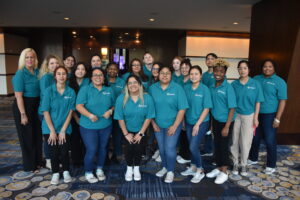
Our 2026 Academy Day is full of amazing learning opportunities! This pre-conference is like no other. Nearly 50% of all attendees include Academy Day when attending the Creating Trauma-Sensitive Schools Conference. This gives you the opportunity to go much deeper into the concepts and neuroscience, much deeper into the strategies and much deeper in how you’re going to use what you’re learning.
When: Saturday, June 27, 2026
Where: Hilton Anatole, Dallas, TX
Two session times – 8:30 – 11:30 am and 1:00- 4:00 pm
All times are Dallas local time at the time of the conference- Central Daylight Time (CDT), which is UTC-5
Please select your preferred sessions when you register. Many have limited attendance and will sell out:
Sat, Jan 27 8:30-11:30 am sessions
Click on each session for more information.
AD1B Emotional Liberation: Fundamental Skills for Future Gazers (Introductory) with Devjani Banerjee-Stevens, PhD
Emotional Liberation is designed to teach the process of healing and resilience. The training is based on the understanding that emotions are data and labeling them accurately will help identify unmet needs, process painful memories, and pinpoint limiting beliefs. The training provides a foundational understanding of how historical and systemic oppression negatively affect brain development, hinder emotional regulation, and hamper the ability to achieve secure attachment. Participants will practice using specific language to communicate effectively through distressing emotions. Once participants have completed this training, they will have the building blocks to ensure that the policies, procedures, and culture of their organizations match the 6 Guiding Principles of Trauma- Informed Care laid out by the
Substance Abuse and Mental Health Services Association (SAMHSA).
Dr. Devjani (Juni) Banerjee-Stevens is an Assistant Professor in the School of Social Work at Chico State University. She also is a licensed psychologist and owner of Deer Park Counseling & Consulting. Juni is interested in how emotional literacy (i.e., accurately understanding, validating, and responding to our own and others’ emotions) facilitates processes that aim to dismantle oppressive systems. In short, Juni is committed to helping individuals, families, and communities heal from trauma, one relationship at a time.
AD1C Trauma-Sensitive Education: A Collaborative Approach (Advanced) with Stacy Nation, MSW, LCSW, BCD Jen Stein, MEd
In this session, co-presenters come to the Trauma-Sensitive table through two different lenses. Jen and Stacy have been collaborating together for several years. Jen is an elementary school principal. Stacy is a mental health clinician. These two will marry the science of trauma-sensitive practices with the actionable steps taken in a trauma-sensitive school. This goes much deeper than trauma-sensitive classrooms; this is the shift of the entire community, including students, parents, staff, and community members.
We will address the following questions with actionable strategies in an interactive setting:
- How long does it take to create a paradigm shift in staff, school, community?
- What needs to be in place for an entire school system to shift?
- What are the challenges and barriers to becoming trauma-sensitive?
- How do we shift the setting that is ready (classroom, school) if the other spaces are not quite there yet?
- What is the timeline for making these changes?
- Who is impacted?
- Who has what roles?
- What does the physical environment and space look and feel like?
- What does the staff, students, and parents look and feel like?
- How does everyone participate?
- What roles do we each play?
- How do we maintain this foundation with staff turnover, new kids, etc.?
This session is appropriate for administrators and educators who are committed to shifting the paradigm of education in their communities. Participants will take a pulse of what’s currently happening in their settings and leave with what the next steps towards implementation.
Stacy Nation, LCSW. Stacy’s passion lies with working with the “tough” kids and their families. She has intense training in trauma-informed practices and excels at providing real-life, applicable strategies to parents, educators, and mental health professionals. Stacy earned a Bachelor’s in Science Degree in Psychology Education from Rocky Mountain College and completed a Master’s in Social Work through Walla Walla University. She is a Licensed Clinical Social Worker, a Behavior Health Officer in the Wyoming Army National Guard, and is a Certified Phase II Clinician in the Neurosequential Model of
Therapeutics. She splits time living in Colorado and Wyoming with her family
Jen Stein, MEd. Jen is an elementary principal in Kalispell, Montana. Her passion for education is anchored in school being a place where all people feel seen, welcomed, loved and have a sense of belonging. She has been an administrator in Kalispell for 12 years when she and her husband Gus moved their family to Montana. Previous to that she was a teacher in Washington for 8 years. She’s had a variety of experiences that have developed her into the educator she is today, none as profound as being a mother to Kaylin and Luke.
AD1D Becoming a Trauma-Informed Restorative Educator, (Introductory) with Joe Brummer (limited to 60)
Welcome to the journey of becoming a trauma-informed restorative educator. This is a journey with no specific destination, and it’s a journey with no end. New research about the impact of trauma and stress on brain development in children, young people, and adults means we have to constantly recalibrate and integrate what we thought we knew with what is newly discovered. This journey is just as much about unlearning old ways of understanding and interpreting children’s behaviors as it is about learning new ways of being with children.
This workshop will explore the 3-part personal, professional, and social justice journey to becoming trauma-informed and restorative. We will discuss what neuroscience is telling us about our current practices, rooted in behaviorism, punishments, and rewards, and a path toward better motivating students through the lens of self-determination theory. We will address what trauma is and isn’t, as well as how it impacts our classrooms. We’ll talk about types of regulation and how educators can learn to co-regulate students through a variety of practices. We will examine the importance of wellness and its impact on regulation, as well as the effects of shame on behavior.
Sat, Jan 27 1:00 – 4:00 pm sessions
Click on each afternoon session for more information.
AD2A Psych Reducing Dysregulation: The Neuroscience of Connection and Resilience, (Advanced) with Kathryn Berkett, MEd
In Aotearoa/New Zealand, schools are struggling with increased levels of dysregulation. Whether it is due to experienced trauma, neurodiversity, anxiety or other causes, the outcome is a substantial increase in stress on our educators. It is well known that a dysregulated adult cannot regulate a dysregulated child. Therefore, we must have strategies that support both the educator and the student.
In Porirua East, an area of high economic deprivation, we have implemented a project that has been going for four years. This project focuses on teaching educators the neuroscience of connection – why it is essential and what it looks/feels like; and the neuroscience of resilience -how to develop it in oneself and in the students. The outcomes of this project are simple, we record how often dysregulation is observed and how long their bodies hold it when they do dysregulate. Through these observations we can see, in a very simple, yet incredibly biologically respectful way, the difference we are making to the stress response of that individual. The outcomes of this intervention have been profound. Statistics such as 47% decrease in the rate of students having one or more observed dysregulated episodes per day and a 43% decrease in the length of time students were staying in observable dysregulated states. Additionally, there were effects beyond behaviour. The project is increasing academic outcomes and lifting attendance rates, despite having zero direct interventions aimed at these goals.
This workshop will outline the neuroscience that underpins the project, detailing how it can be taught to others. Attendees will leave with the understanding of how to utilise this incredibly powerful and effective mode of biologically respectful change.
Kathryn Berkett, Engage Training Ltd, Lyall Bay, New Zealand. Kathryn is a distinguished speaker and neuroscience expert with over fifteen years of experience. With a Master’s in Educational Psychology and certification as a Neurosequential Model of Therapeutics practitioner, Kathryn specializes in bridging the gap between neuroscience and real-world applications. Currently pursuing a second Master’s in Applied Neuroscience at King’s College London, Kathryn is dedicated to advancing our understanding of brain development and human behaviour. Kathryn is the author of What is Going on in There: Neuroscience of the Adolescent Brain. She also hosts the podcast series I’ve Got Questions and has a TEDx Talk titled Neuroscience of Device Zombies.
AD2B Creating Communities of Care, (Introductory) with Martha Merchant, PhD
This professional learning session is designed to support educators and other school staff in strengthening both personal and collective resilience through trauma-informed, healing- centered, and equity-driven practices. In alignment with the Heart Core Consulting guiding principles, the training addresses the profound impact of stress, burnout, and secondary traumatic stress on educational professionals—and offers practical, culturally responsive strategies to promote wellness, connection, and sustainability in school communities. It will begin with building a stronger knowledge of ourselves and will provide a frame to move through wider circles of influence so that participants leave with practical ideas on how to create and maintain a strong community.
The goals for this session are:
1. Understand the effects of stress and secondary trauma on educators and staff
2. Identify strategies to strengthen individual and collective resilience
3. Practice three strategies to increase knowledge of self and others.
4. Describe how communities of care can mitigate the effects of trauma.
5. Demonstrate three effective skills to create a community of care.
6. Examine how healing-centered and equity-focused practices support long-term systemic change.
Martha Merchant, PsychD, Heart Core Consulting. Dr. Martha Merchant has worked with children, youth, and families who have experienced trauma for the past 20 years. She earned the title doc Martha while working in schools for the past 13 years. Doc Martha is a biracial Korean/white, non-binary person and abolitionist,working to empower others and to change the systems of oppression that exist all around us.Her colonial credentials (M.A. in Marriage and Family Therapy and her Psy.D. in Clinical Psychology) are from the Minnesota School of Professional Psychology. Doc Martha provides training and consultation to create more trauma-informed, racially just, safe, and supportive school environments.
AD2C From Hearing to Healing: Building Restorative B.R.I.D.G.E.S. to Students, Families and Staff, (Introductory) with Carmen Zeisler (limited to 75)
Do long-term suspension and expulsion hearings feel like the hardest part of your role as a school leader?
You’re not alone. Many leaders wrestle with how to address serious behaviors while also wondering if—and how—a student might return to school successfully. It often feels terrible to expel a student. Sometimes, it’s unavoidable. And while we exhale after the storm, the student is often left more disconnected and vulnerable than ever.
In this session, discover how building B.R.I.D.G.E.S. can help restore relationships, repair harm, and pave a new path forward for everyone involved. This approach isn’t just about the student—it’s about all the stakeholders: families, teachers, administrators, counselors, SROs, and others who sit at the table during a hearing. You’ll leave with practical tools to address behaviors before a hearing becomes necessary, along with strategies to use during and after the suspension or expulsion process. We’ll explore the use of empathy maps and restorative reentry circles that highlight student strengths, acknowledge areas of concern, and create space for honest, forward-focused conversation. Together, we’ll build actionable plans for both connection while students are away and upon their return –ensuring that every voice is heard and every need is considered.
Come ready to build your plan with people who are doing this work daily—leaders and practitioners committed to repairing harm and restoring connection at every level.This session will help you turn one of the most challenging aspects of school leadership into an opportunity for healing, accountability, and transformation—for students, families, and the entire school community.
Carmen Zeisler is the Director of ESSDACK Learning Centers, an Educational Consultant/Coach, and a co-founding member of the ESSDACK Resilience Team. She leads Project-Based Learning redesign efforts and supports trauma-informed and restorative justice practices in schools. Carmen helps educators build strong reading cultures, often using picture books to bring science and social studies to life. With a background in international teaching, she’s taught in Mexico and Brazil and visited 33 countries, enriching her work with global perspective. Carmen is also skilled in classroom technology integration. Her greatest strength is building relationships and asking meaningful questions that spark passion and purpose.
AD2D Active Hope: An Experiential Workshop Using the Work that Reconnects to Transform Educator Despair, (Advanced) with Sheri Kreher, LCSW-R (limited to 50)
Are you an educator or school leader feeling overwhelmed, disconnected, or demoralized? It is possible that what you are calling “burnout” is actually something deeper—a symptom of moral injury, vicarious trauma, or trying to work in a fractured system. This 3-hour experiential workshop offers a powerful, healing journey through The Work That Reconnects (WTR), a group process developed by Joanna Macy, rooted in systems thinking, deep ecology, and engaged Buddhism. Widely used to support people in demanding, heart-centered vocations, WTR offers a spiral process that helps participants move from despair to empowerment, from isolation to interconnection, and from apathy to active hope.
Together, we will walk through the four stages of the WTR spiral: Coming from Gratitude, Honoring Our Pain, Seeing with New Eyes, and Going Forth—specifically framed around the lived experiences of educators today. This is a fully participatory, facilitated experience. Through guided one-on-one and small-group conversations, participants will reconnect with themselves, one another, and the deeper purpose behind their work. Come prepared not just to learn, but to feel, to share, to grieve, and to reimagine. Through WTR, we remember that we are not alone—and that active hope is not wishful thinking, but a practice of courage, truth-telling, and regeneration.
Community agreements: Attendees agree to participate in good faith, to share and listen with respect for others’ experiences, to avoid sharing traumatic details, to avoid using identifying information of students or other staff, and to maintain confidentiality of fellow participants.
Sheri Kreher, LCSW. Sheri is a licensed clinical social worker with twenty years of mental health experience. She works for Genesee Valley BOCES as the Trauma, Illness and Grief Coordinator for multiple school districts. Sheri coordinates crisis response teams during school emergencies and critical incidents such as student or staff deaths or any incident with broad mental health impact. She also provides comprehensive training to staff and administrators on trauma-informed care, critical incident preparedness, suicide and threat assessment and intervention. She is also the Employee Assistance Program Coordinator, helping hundreds of teachers and school staff cope with the struggles of working in the field of education.